



In the diminishing days of a tumultuous legislative session in the Capitol of Montana, Carl Glimm, a state senator and member of the Caucus of Ultraconservative Freedom, observed with exasperation as another bill backed by democratic approached to approval.
“Are we not ashamed?” Mr. Glimm asked from the Senate floor in Helena. “This thing is a great” no “red, but I will tell you what will be 23-27,” he added, predicting his own defeat. “Because, as we have said before, the cake is baked.”
In deep red Montana, the Republicans have controlled both Chambers of the Legislature since 2011, and the Governor’s Office since 2021. They expelled the last remaining democratic official, former Jon Tester senator, in November.
What has made it even more aggravating for coexistence legislators to find themselves effective in the minority this year.
After an Intraparty dispute in January, nine Republican state senators began to break with their caucus in key votes, rising with the 18 Democrats in the 50 people’s chamber. The result: a majority of 27 people who have almost locked Republican leaders out of power.
Some or all nine, as republican deserters are known, have voted with the Democrats to reauthorize an expansion of Medicaid, establish a child tax credit, increase access to maternal medical care and approve the state budget. They have helped block invoices that would have fabric labor unions, made state judicial elections more partisan and establish an unlimited hunting season in Lobos.
On Wednesday, the last day of the session, they again broke with their group, promoting a reduction of property taxes to help residents fighting with the high housing values.
The unusual alliance shows that, despite all the apparent unanimity in the Maga Movement, Republicans can still collide with the policy objectives and the exercise of power. And at a time when Lost’s legislation progresses to make fun of the opposite party, it shows that some on the right are still more interested in doing things.
But I could prove a species: a reversal to the past reflexes towards Montana’s constant drift to the right.
Former governor Brian Schweitzer, a Democrat, said politicians in other places could learn from nine.
“What they have done is said: ‘I will vote with the people I represent at home, and that is not what the leadership of the party is us,” said Schweitzer.
“We will take to Congress here to see that it is doe in Montana,” he joked, and added that “he would put the first $ 50” for the bus rate.
Part policy
The nine argued that they simply prioritized the intelligent policy on ideological conformity, so the medicaid expansion would maintain open rural hospitals in their districts, for example, and supporting the agenda promoted by Governor Greg Gianforte, also Republican.
But as President Trump exercises almost total control over the Republican Party, and the country seems bitterly divided along partisan lines more than ever, the Republican Schism in Montana has attracted scene attention.
As the session progressed, other Republicans of Montana increased a pressure campaign against deserters, publishing their photos on social networks, demanding that they stop tearing the leadership of the party and give them nicknames such as the “Nasty Nine”. In March, the Republicans tried to expel one of the heretics, Jason Ellsworth, of the Legislature on alleged ethical violations; Most of the Democrats helped block the attempt.
The Republican Party of Montana even censored the nine, saying that they would no longer be considered Republicans or receive funds from the state party due to “the lady they have demanded in the Senate of Montana.”
The nine remained optimistic. Days before the legislative session ended, seven of them sat for an interview in the State Capitol, describing praise of voters, exchanging warning stories by local Republican groups and declaring that such criticisms only had a resolution.
“I always looked at politicians when I was young and you see people work in the hall,” said Gayle Lammers, a first -term senator. “I know that we are in this new era where the division is so hardcore, but why can’t we return to where any unpleasant legislation is a prescription legislation? If it is good for Montana, if it is good for its district, why not consider it?”
Although they have voted with the Democrats, the senators say that they are still conservative and strong supporters of Mr. Trump. All of them voted for a bill that restricts the use of public bathrooms of transgender people, and most of them were put on the side of their republican colleagues in several anti -abortion bills. Josh Kassmier, who emerged as the Nine leader, said he had sponsored a bill cutting the Income Tax, a measure backed by Donald Trump Jr.
From the office of Mr. Gianforte Toke in 2021, Mr. Kassmier said: “We have reduced the budget, we have made the government more efficient, that is the entire Trump policy, right?” He added: “We are voting on politics. It is not an agreement that we have made with the others.”
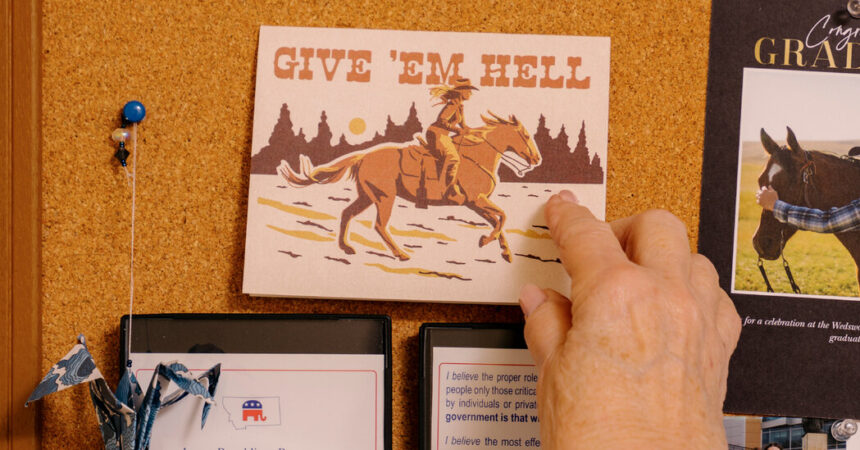
One of the nine, Wendy McKamey, keeps a pile of mounted notes on your desk, thanking the group for their courage. “Leave them hell,” reads at the front of a card, on an image of a cowgirl to horcajadas on a galloping horse.
“They help me own my vote,” McKamey said. “I will not offend my conscience.”
He thought that the political lines of the legislature seemed blurred, some legislators and analysts suggested that the true crack was among those who wanted to do policies and those who tried to obstruct it.
“It’s about who is more interested in governing, really,” said Jessi Bennion, professor of Political Science at Montana University. Montana’s right wing, he said, seemed less interested in conservative fiscal policy than in the introduction of controversial bills on social matters that expanded the legislative process.
That put the hard lines in a collision course with Mr. Gianforte, who did not support Matt Regier, the president of the right -wing Senate, last year, but supported a group of relative moderate. The Caucus de la Libertad issued a refutation to the state of the state of the state of Mr. Gianforte in January, suggesting that Montana shoulder less money from the governor wanted and opposed some of his priorities, such as the expansion of Medicid.
Mr. Gianforte has avoided talking directly, about nine, and a governor spokesman declined to comment. But he seemed pleased to have achieved many of his goals.
Intense setback
Despite the recent drift to the right, Big Sky Country has been proud of his independent streak and his small town values. Montana has voted for a democratic presidential candidate only once since 1964, Bill Clinton in 1992, but had democratic governors and senators for decades.
In previous legislative sessions, which occur every two years, a loose coalition of Republicans called Caucus de Solutions worked with Democrats to approve bills. But that was easier for Republicans to swallow when a Democratic governor made it necessary to commit.
What stood out about the bipartisanship of this year was the animosity it produced.
The conflict began the first week of the legislative session, when the nine were assigned to what were a simulated committee that would have left them aside from the legislative process, part of an effort, they argued, to facilitate Mr. Director and his allies to consolidate power.
The senators retreated, according to the Democrats in the Alternative Committees assignments. From there, they said, the Democrats were very happy to work with the nine in some bills.
In an interview, Mr. Regier called the Bipartisan Alliance a “bowel blow.” He said that none of the nine had raised concerns about committees assignments when the Republicans before the session, and suggested that unhappiness was a “point of conversation” that provided “the Democrats sideways.” The efforts to recover them, he said, had rejected.
“We try and try,” said Regier. “It was obvious to see that there was some kind of handshake, friendship, collaboration with the Democrats.”
Mr. Director denied that the right -wing Republicans were obstructionists and sounded dumbfounded by the role of the nine when enclosing them from the legislative process. “You are scratching your head like” Are you already in our team? “
Hello, he also argued that the unlikely alliance was out of tune with the electorate.
“Voters want more and more conservatism here in Montana,” said Regier, a suggestion that the episode was equivalent to “growing pain in being more conservative.”
The Democrats also felt heat for their role in the coalition, from the left. Bill Lombardi, a former main assistant of Mr. Tester, criticized Democratic senators for voting with Republicans on issues such as maintaining a social security tax.
“While working together is good, they can’t give away democratic principles,” Lombardi said. “Republicans have consolidated their position in Montana, and some legislative democrats think they are dedicated to the moderate republican line to obtain something.”
But frustration seems stronger to the right.
Theresa Manzella, founder of Freedom Caucus, said that the right -wing state senators had tried to make the nine go down but possible tired of the fight.
“We resign ourselves to life in the circus,” he said. “And, unfortunately, it is our circus, and the thesis is our clowns.”