


In a pharmaceutical factory in Chengdu, China, an order that Thomas Leung placed from Manhattan in January is waiting.
Shipping includes a variety of concentrated herbal granules used in traditional Chinese medicine. There is Gui Dang, also known as Root Angelica, which is used to treat gynecological ailments; Chai Hu, or Bupleurrum root, a herb that is used or used to calm the nerves; and Huang Qi, or Root of Astragalus, a tonic herb that promotes immune force.
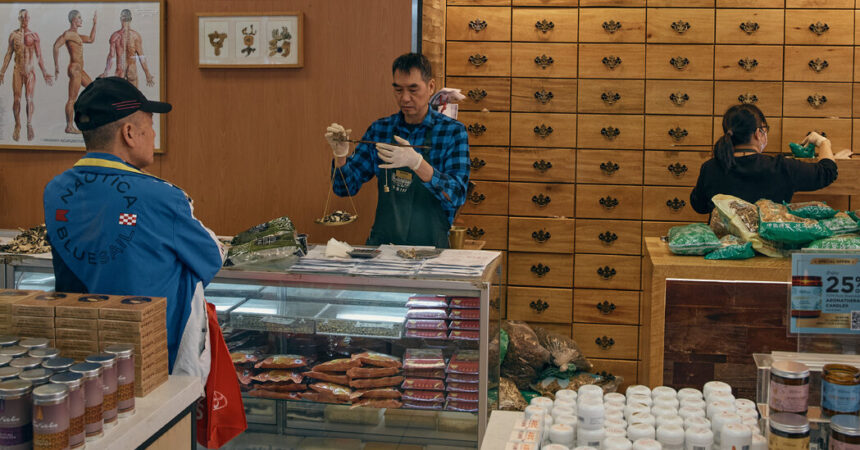
It is not clear when the shipment will land in Kamwo Meridian Herbs, a basic element of New York City for more than half a century that claims to be the largest traditional medicine dispensary on the east coast. When you arrive, herbs will dispense professionals and patients seek to treat colds, pain and other ailments, but for now, herbs should sit.
Dr. Leung, executive director of Kamwo, stopped the order after President Trump made a minimum tariff or 145 percent in all Chinese products last month. China responded by raising tariffs on US goods to 125 percent, and the resulting confrontation has an effective frozen trade between the two countries.
Traditional Chinese medicine is only one of the many industries that has turned to tariffs and uncertainty about when, or if they can be raised. Already, fewer ships arrive at US ports, and consumers could begin to see empty shelves in early June.
The commercial war has caused paralysis among imports, said Dr. Leung, a fourth -generation Herbal pharmacist and the third member of his family to lead Kamwo. Even if well, willing to pay the import duty, he said, he would risk Bee trapped with prohibitive faces that few people would be willing to buy if tariffs are invested.
“No one is doing anything until we know what Devils is happening,” he said.
Since opening its doors in 1973, Kamwo has filled recipes written by traditional Chinese medical professionals and sold herbs per pound. Recently, however, he stopped announcing bulk sales. With effective imports in pause, there has been a race in herbs and supplies that have already come out prices to jump, Dr. Ir. Said Leung.
Space and time also limit how much can be supplied with the typical Chinese medicine dispensary in these supplies. Herbs can go wrong or grow raids, and even if it were possible to store a great supply, there is the question of where everything is stored.
Before the tariffs were announced, Kamwo hoped to receive $ 6.5 million in income this year, Dr. Ir. Leung said. Kamwo is lucky to be a larger company that has “perhaps eight months of herbs” by hand, he said, but “not all narrower companies will have that luxury.”
Thin margins, high stakes
Traditional Chinese medicine, or TCM, has been welcomed in the last 20 years, driven by immigration and a will among US consumers to try something new when they look for relief, said Arthur Dong, a professor of teaching at the University of McDonough.
It is an exactly how large uncle is the TCM industry in the United States. China exported almost $ 5.5 billion in traditional Chinese medicine in 2023, compared to $ 3.6 billion in 2017, according to statista.
A prolonged commercial war would damage the TCM industry as well as other sectors, but popular sectors that depend largely on imports. Jaya Wen, an assistant professor at the Harvard Business School, said TCM “is likely to be highly announced in relation to other industries.”
Many dispensaries are small mothers and pop stores that operate in thin razors. Once they are left without stock, they will stay with naked shelves, without incoming businesses and a rental check that is due each month. Tariffs could also threaten people’s livelihoods throughout the supply chain, including store associates that gather orders and truckers who rub thesis ingredients to their final destinations.
Many of the herbs used in TCM cannot grow outside of China, said Dr. Leung, and are processed by qualified workers, following highly specialized methods that were established made generations.
“If I make a list of all the things we must do to foster that, like a Chinese herbal industry in the home in the United States, it is impossible,” he said. “It’s literally impossible.”
The interruption of TCM in the United States “will be quite widespread, and this is just a narrow industry,” said Dr. Dong. “This is one of the thousands of industries that will be affected.”
Because Trump changes his mind frequently, said Dr. Dong, it is difficult for companies to plan the future. That is why “you’ve seen that trade gears stop.”
“No CEO of any company, whether large or small, is willing to make investments or get loans or increase a trade or commit to anything beyond the next two months due to this uncertainty,” he said.
Even so, despite the economic challenges, Ga Donovan, a member of the Institute of Policy of the Asia Society, said “would not count this industry.”
TCM practitioners in China experienced a “very turbulent twentieth century,” he said, referring to the violent political absorption Divis or the cultural revolution of Mao Zedong. As a result, he added, “they have the resistance to handle this.”
“You could expect them to respond to this challenge with great ingenuity,” he said.
Treatments for ‘Common People’
Kamwo is sent to the 50 states, Canada and Europe, and about 75 percent of their customs are not Chinese, Dr. Go. Leung said.
Among them is Lyn Pierre, 58, who entered Kamwo with a sunny Friday afternoon looking to fill his recipe. A broker, has used TCM in Varouse Points in his life to stay free of injury, but now he is concerned that the medicine already expensive will cost even more.
“Or, of course, I am worried,” said Mrs. Pierre, sitting in a stool inside the store, adding: “I think it will be a little expectation.”
Mrs. Pierre said it is already difficult to make a living, especially these days of high costs. The idea that herbs cost even more than they already do is discouraging.
“It’s not easy,” he said. “It’s really a fight.”
Acupuncture, the former Chinese medical technique for pain relief, could also feel the impact of the commercial war.
Dr. Beth Nugent, president of the New York Acupuncture Society, said that most acupuncture professionals “operate in very thin margins,” and added that she and her colleagues “tend not to charge people a lot because we simply love what we do.”
Herbs, tonic and needles are essential for the practice of Dr. Nugent. While there are other sources for some articles, such as needles, “it may not be as high quality as we can get from China,” he said.
“If I could charge someone the minimum amount offered to come for acupuncture, that is what I am going to do,” he said, “but it reaches a point where I can’t keep the lights on in my practice?” “
He is concerned that patients who do not see if they are forced to increase prices, perhaps because they can no longer pay the treatments. She thinks of the hockey player who helps on the ice, the couple that finally Coneó after fertility struggles and the patient with vertigo who stood up.
“This is not something esoteric or something outside the kingdom or common people,” he said. “It is the common people who receive this treatment.”